
Verify Spanish Fork Voter Registration
Begin a voter registration check at Utah's Voter Information portal. It is an identity-gated self-service tool, not a public directory for browsing Spanish Fork residents by name. Choose the registration-status option and enter the three labels the official application presents. The private birth date helps verify that the person requesting the result is the voter. Utah describes the result as current registration status and polling information, but the application does not publish a complete sample result without real voter data.
| Field | Type | Required | Notes / Format |
|---|---|---|---|
| First Name | Text | Not exposed | Use the official label; no exact-match rule is published. |
| Last Name | Text | Not exposed | No address or ZIP field is shown in the inspected form. |
| Date of Birth | Date or text | Not exposed | Private identity verifier, not a public result field. |
| Search / Clear | Buttons | Not applicable | Submit the lookup or clear all entered fields. |
The direct Find Voter Registration Status application is the quickest route for one's own record. A failed match does not open the statewide voter roll. Check spelling and the personal date entered, then contact Utah County Elections when the result still seems wrong.
Preview the process on Utah's official Voter Information portal.
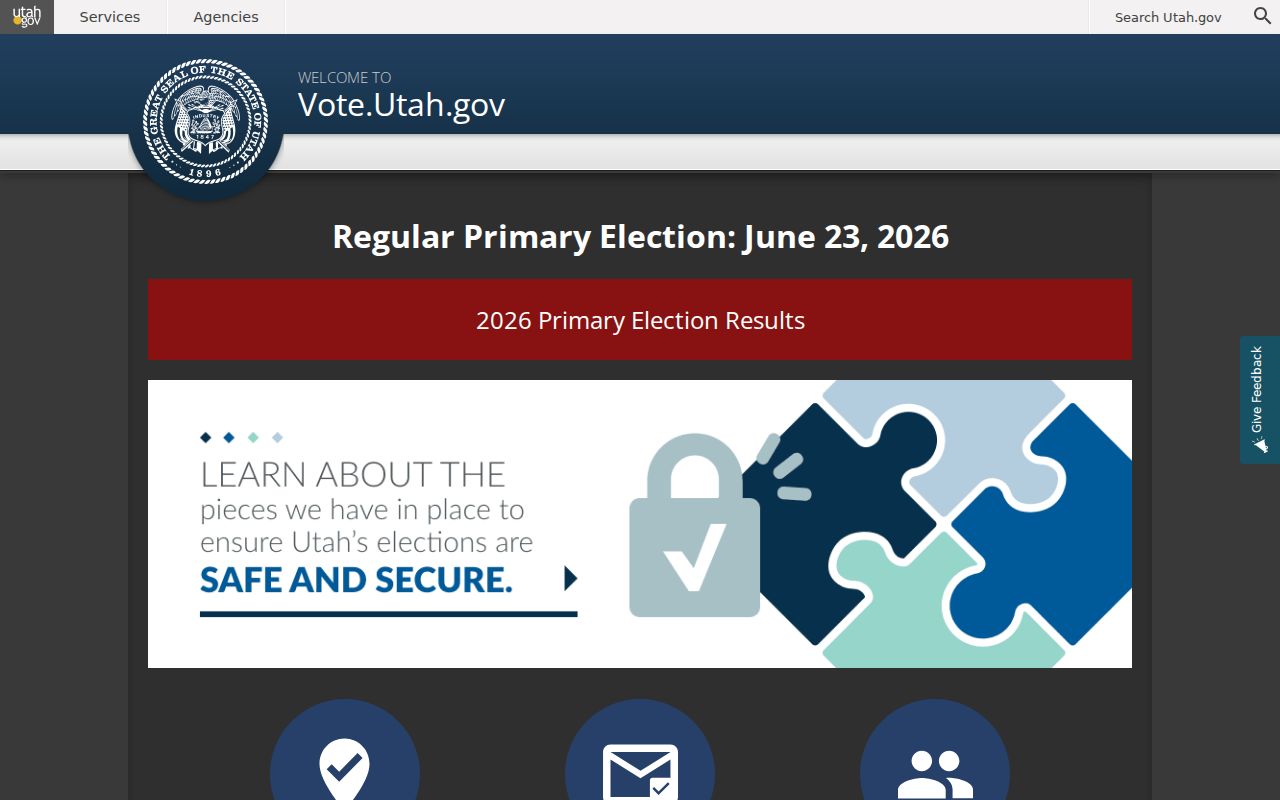
The captured screen shows the government gateway that routes a Spanish Fork voter to status, polling, and ballot tools.
Fields in Spanish Fork Voter Records
The public bulk record is broader than the self-lookup result. Under Utah Code §20A-2-104, a standard entry can identify a voter and place that person in the correct precinct and districts. Participation history records which elections a person took part in. It does not reveal a candidate, question, or ballot choice.
| Full legal name and voter ID | Public file identifiers unless the voter is protected as at-risk. |
|---|---|
| Age range | Public range; the exact date of birth stays private. |
| Residence and mailing address | Public, including unit and city, unless at-risk protection applies. |
| County, precinct, and districts | Shows congressional, legislative, school board, county, and city council assignments. |
| Party or unaffiliated status | Shows the Utah affiliation on the record. |
| Participation history | Lists elections participated in, never selections made on a ballot. |
| Status and update date | Shows active or inactive status and the last registration update. |
A voter ID is a record key, not proof that two people with similar names are the same person. District fields also change when political boundaries or a residence change. Compare the county, precinct, status, and update date before drawing a family-history or civic conclusion from an entry.
Spanish Fork Voter Privacy Lines
Utah separates public roll fields from private registration details. The distinction matters because the self-lookup uses a private fact that does not then become a public search field. A registration form may collect more information than the released voter file contains.
Confidential under Utah law. Utah Code §§20A-2-104, 20A-2-607, and 63G-2-302 govern release and privacy. Exact birth date, driver-license or state-ID data, Social Security number, email, and phone are nonpublic. Signature and supporting privacy material are also withheld, while an at-risk voter's public identity data is anonymized.
The public/private split cannot be bypassed with a general records request. The broader Spanish Fork public records process may reach a specifically described existing election record, but it does not cancel voter-specific privacy rules.
Spanish Fork Voting History Limits
Participation history answers a small, exact question: whether the record shows participation in listed elections. It cannot show how the voter marked a ballot. The same line applies to the state's daily election products. A “Who Has Voted” report can show vote method and the date a ballot was processed, yet it still contains no candidate or issue selection.
This limit protects the secret ballot and keeps voter records from being read as political profiles. Use participation data for lawful civic or family research only. Never treat an election appearance as evidence of support for any person or proposition.
Does an election report reveal vote choice? No. Utah's public data records participation and processing facts, not the selections made in the voting booth.
Note: At-risk identities and private registrations are excluded from the election activity products released by the state.
Order Utah's Statewide Voter File
The Lieutenant Governor provides a statewide product, not a Spanish Fork-only extract. The official voter data request route states the charge, delivery format, and statutory-use acknowledgment. The one-time file costs $1,050. It has no subscription, refund, or free update. Delivery is normally an emailed download within one business day.
- Select the statewide registration product on the official election-data request route.
- Supply the required identity and contact details, then accept the election-data use restrictions.
- Pay the $1,050 one-time charge and receive the tab-delimited download by email.
- Use software that can handle an approximately 150 MB file, since ordinary spreadsheet row limits may be too small.
The state request page is the documented entry point for the full voter roll and election reports.
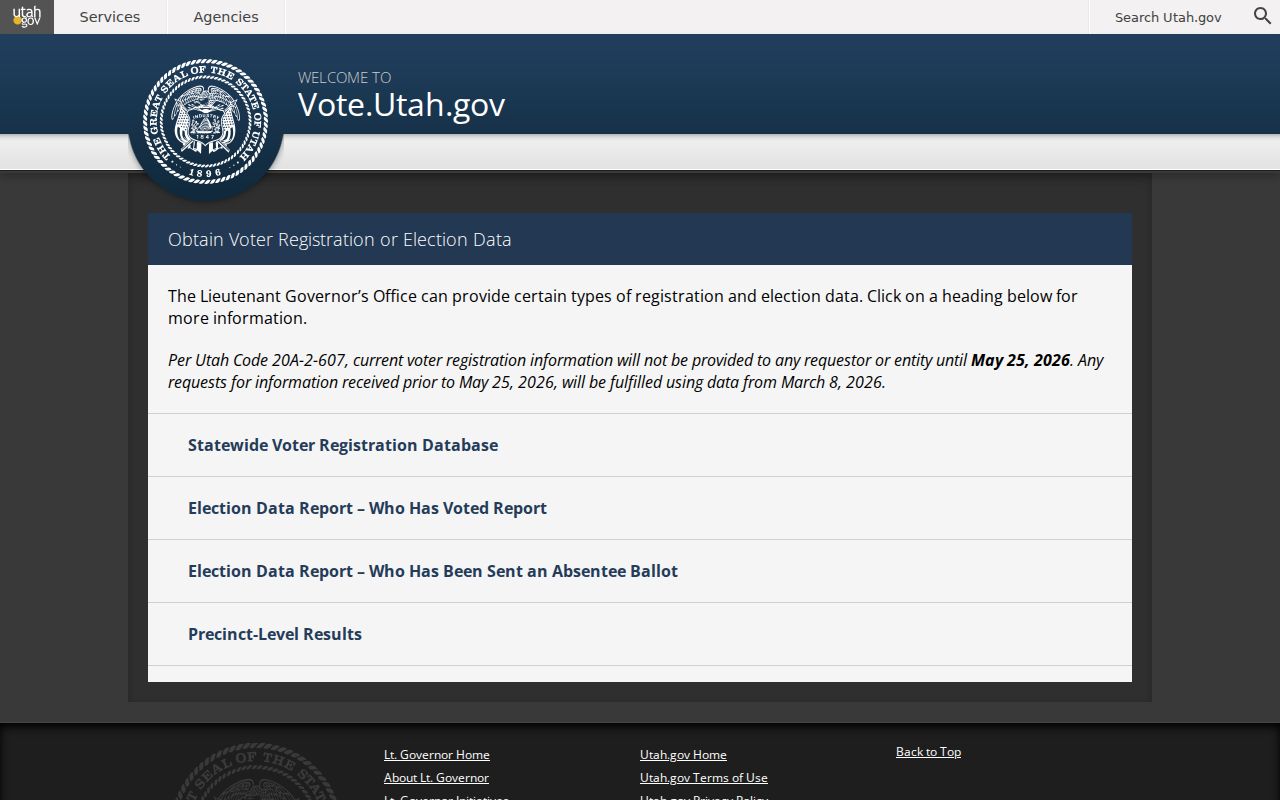
The screen helps distinguish the paid statewide data product from the free personal status check.
After delivery, filter the statewide rows by county, precinct, or district to isolate Spanish Fork records. Keep the file's public nature in context. The request acknowledgment and Utah election law restrict use, while the private fields listed earlier are not supplied for reconstruction. Voter ID, age range, address, affiliation, status, district assignments, and participation dates must be read as separate fields. None turns participation into proof of a ballot choice.
Request Spanish Fork County Voter Data
Spanish Fork lies in Utah County, while Provo is the county seat. That records geography controls the request route. A county or district subset must come from the Utah County Clerk rather than the Lieutenant Governor's statewide-only product. Utah County has not published a subset fee or dedicated form in the research materials, so ask Elections for the current scope, format, and charge instead of assuming the state price applies.
Utah County Elections
100 E Center St #3100
Provo, Utah
801-851-VOTE
elections@utahcounty.gov
Contact is available in person, by phone, or by email through the Utah County Elections office. A written GRAMA request is another route for a specific existing election record. Name the record, dates, and desired format clearly; Utah's general act normally uses five business days for a request that benefits the public and ten business days otherwise, subject to stated extraordinary circumstances.
Check the official Utah County Elections details before a visit or request.
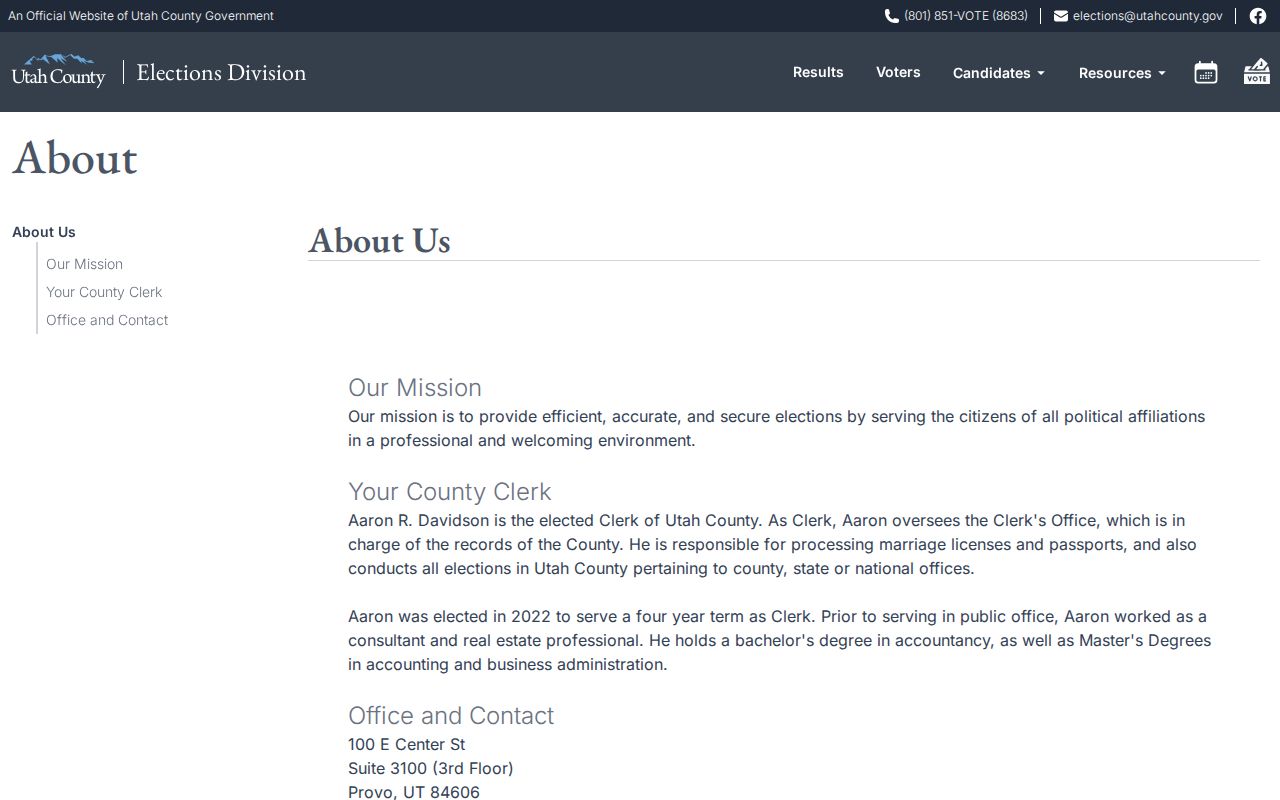
The county contact page confirms which office administers Spanish Fork elections and county-level voter data.
Utah Election Activity Reports
Two paid reports track election administration without exposing ballot choices. “Who Has Voted” costs $35 for an election and is supplied daily during the 21 days before an even-year regular primary or general election through the day before Election Day. Its fields include voter ID, name and address, county, precinct, congressional district, vote method, ballot processed date, and affiliation.
“Who Has Been Sent an Absentee Ballot” follows the same $35 framework and adds ballot order and processing dates. Precinct results are free on request. These products serve a different purpose from the registration list, and none supplies protected voter records or private registration details.
When Spanish Fork Voter Records Inactivate
An inactive label does not mean the record vanished. Utah describes inactivity as not voting in two regular general elections and then failing to respond to a clerk notice. Monthly list-maintenance reporting covers confirmation cards sent and returned, plus removals tied to death, inactivity, a voter request, and other stated reasons.
State administrators also run weekly duplicate checks and a review before ballot mailing. On July 20, 2026, Utah reported 2,088,612 registrations, including 1,778,184 active and 310,424 inactive. Utah County reported more than 371,000 registered voters in 2026. These totals are snapshots, not permanent counts, so current status should come from the personal lookup or elections staff.
Note: An inactive status is an administrative category; it should not be treated as proof that a person left Spanish Fork.
Protected Utah Voter Addresses
At-risk classification protects qualifying threatened people, domestic-violence survivors, law-enforcement personnel, protected persons, armed-forces members, public figures, and their co-residents. Government may still use the underlying voter record, but public identifying data is anonymized. Beginning in January 2027, a voter may consent to release phone or email to an affiliated party; those contacts otherwise remain nonpublic.
Utah's Safe at Home program is a separate safeguard. It provides a substitute address and mail forwarding for qualifying people facing abuse, stalking, sexual assault, trafficking, or threats. Election officials may need an actual location to assign districts, but they must conceal and protect it. Public voter data must never be used to rebuild a protected location.
Use records lawfully. Utah stalking law §76-5-106.5 covers repeated monitoring and obtaining or sharing information that causes reasonable fear or emotional distress. Electronic communication harassment is addressed by §76-12-202.
Spanish Fork's 1890 Voter Register
Modern voter registration data is a live administrative file. The historical counterpart is one compact volume: Utah Archives Series 30402, Spanish Fork's alphabetical precinct registration book from 1890. It was certified and filed on June 30 of that year. The register is public and reproducible, and it can supply historical residence evidence for genealogy or community research.
Use the Utah State Archives research gateway to locate the series and arrange reference help. Archives research is appointment-based. The published turnaround is 8 to 12 weeks, and certification costs $10 per document. Those terms concern the historical archive, not a modern voter-file request.
A century-old name can help trace a family or neighborhood, but it cannot prove present registration eligibility. Spanish Fork was chartered in 1855, and its surviving government series span many record systems. Read the 1890 book in that historical setting, especially when names repeat across generations.